The Return
Vulgar Army is returning 2024. More information to follow.
An article on the impact of Victor Hugo’s representation of the octopus in “Les Travailleurs de la Mer” (Toilers of the Sea). This article was published a few years after Travaillieurs was published in French in 1866 and later that year in English (in New York).
“THE OCTOPUS—DEVIL-FISH—OR MAN-SUCKER." Kapunda Herald and Northern Intelligencer (SA : 1864 - 1878) 19 Mar 1872: 4. Web. 11 Dec 2013 <http://nla.gov.au/nla.news-article108269081>.
THE OCTOPUS – DEVIL-FISH – OR MAN-SUCKER
It is a curious feature in human curiosity that when a great novelist or a great poet writes about an animal, the beast immediately becomes celebrated. It may itself be common enough, but when invested with a halo of mystery—and novelists and poets are generally not famed for a pro-found knowledge of natural history—it suddenly becomes the hero of the public mind. Victor Hugo wrote about the Octopus, or man-sucker. Of course, like theYankee showman, he made his yarn "as good as be could.” An Octopus arrives at the Crystal Palace aquarium; the directors and Mr. Lloyd found that their new treasure fortunately became a subject of correspondence in the Times, and for many days we have a good deal about “sea monsters."I have been to see the Octopus; he certainly is a very fine specimen. As he sits in a squat position at the bottom of his tank, his head is amazingly like that of an elephant- a similarity which is fully carried out by the continual wave-like motions and curlings of his long prehensile arms.I am, in fact, rather surprised that this animal has not attained the name of "the water elephant,"—a same certainly more appropriate than devil-fish for he is not a fish and there is nothing diabolical about him. It would be interesting to get a series of drawings of the various or fans of prehension, as found in animals.
We should have upon our lists the proboscis of the elephant, the mouth of the leech, the foot of the New Forest fly, the head of the tape-worm, the curious apparatus on the head of the remora, or sucking-fish, the spider monkey’s tail, &c.The body of the Octopus is of the shape of a very large swollen pear. It also reminds one of the body of a fat spider. The arms, or "cephalic processes,” in theOctopus are (as-the word implies) eight in number. The preparation No. 2,080, in the Royal College of Surgeons, shows the suckers. “These suckers are sessile in this species of Cephalopod, and consist of expanded circular discs formed by a duplicature of the integument including radiating and circular muscular fibres. The inner surface of the disc is marked bylines which converge to the margin of the central cavity; the bottom of this cavity is occupied by a muscular substance which can be protruded and retracted like the piston of a syringe. When the animal applies the sucker to any object to which it is to attach itself, the piston is raised and the cavity obliterated ; it is then withdrawn and a vacuum is produced, which can be further increased by a retraction of the central part of the disc itself, when the adhesion produced by the surrounding atmospheric pressure is so great, that in the living animal the arm may be torn off before the suckers will yield.” This is certainly a marvellous piece of mechanism well worthy of study, and even imitation, by engineers.
Some years ago, when fishing for whiting at Folkenstone, a great “mansucker” (asthe Octopus is there called by the fishermen) came floating past the boat; I put my hand and arm into the water in his way. In an'instant the long arms were coiledround my hand, quick as the end of a driving-whip twists round a gig-shaft; the brute did not bite me—at least, if he had I should have recollected it. In the centre of the eight arms is the beak ; this is in shape like a parrot’s beak, but not nearly so hard or strong. The substance into"which his beak is set is something like a bit of muscular tripe ; therefore I do not think that the bite of the Octopus would be very bad. A discussion has taken place in the Times as to whether the Octopus would seize a man or not. Certainly he would, if he got near him in the water, though not with the intention of swallowing him, but because he would cling to anything moving.Mr. Bartlett tells me the curator of the aquarium at Havre informed him that one day, when he was cleaning out the tank in which his Octopus was confined, the animal whipped his sucker-armed tentacles round his bare leg, but the man prevented the beast biting him by grasping him round the body by the mouth. I do not think anOctopus would come out of water to attack a man, nor would he, I think, “ fly at ” a man ; for the Octopus moves by going"stern foremost,“ his long arms being stretched out behind his head, looking like the legs of a heron when flying.
The Octopus of the British seas is comparatively a small animal, but in tropical seas there exist, no doubt, Octopi of enormous size. In the ” Naturalist Library,“Vol. 8, Marine Amphibiae, we have the following evidence: -
Mr. Pennant, in his description of the eight-armed cuttlefish, mentions— ‘That in the Indian seas this species has beenfound of such a size as to measure twelve feet in breadth across the central part, while each arm was fifty-four feet in length, thus making it extend from point to point about120 feet. He further states that the natives of the Indian Isles, when sailing in their canoes, take care to be provided with hatchets, in order immediately to cut off the arms of such of these animals as happen to fling them over the sides of the canoe,lest they should pull it under water and sink it.’ The opinion of Dr. Shaw is equally decided regarding the occurrence of this animal:—'The existence oi some enormously large species of the cuttle-fish tribe in the Indian northern seas can hardly be doubted; and though some accounts may have been exaggerated, yet there is sufficient cause for believing that such may very far surpass all that are generally observed about the coasts of European seas. A modern naturalist chooses to distinguish this tremendous species by the title of the colossal cuttle-fish, and seems amply dis-posed to believe all that has been related of its ravages. A northern navigator, of the name of Liens, is said, some years ago, to have lost three three of his men: in the African seas by a monster of this kind; which unexpectedly made its appearance while these mea were employed, during a calm, in raking the sides of the vessel. The colossal fish seized three in its arms, and drew them under water, in spite of every, effort to preserve them: the thickness of one of the arms, which was cut off in the con-test, was that of a misen mast, and the sucker of the size of por-lids.’
But the most zealous author who treats of this animal is undoubtedly Denys Mont-fort. In his work on the natural history of the Mollusca there are many instances mentioned of its occurrence in various parts of the world, the particulars of which he was so fortunate as to procure from those who were eye-witnesses of what he relates. He gives in detail the circumstances above alluded to by Dr. Shaw from the account as supplied by Dens himself; and, among other instances, he mentions that at St.Malo, in the chapel of St. Thomas, there is an ex voto or picture deposited there by a crew of a vessel, in remembrance of their wonderful preservation during a similar at-tack off the coast of Angola. An enormous cuttle-fish suddenly threw its arms across the vessel, and was on the point of dragging it to the bottom, when the continued efforts of the crew succeeded in cutting off the tentacles with swords and hatchets.
During the period of their greatest dangerthey invoked the aid of St. Thomas, and, being successful in freeing themselves from their dreadful opponent, on their return home they went in procession to the chapel, and offered up their thanksgivings. They also procured a painter to represent, as accurately as possible, their encounter, and the danger which at the moment threatened tlte termination of their existence.—•Land and Water.
Coming nearer home, we quote thefollowing on the same subject from the Belfast (Victoria) Correspondent’s of the Hamilton Spectator letter of the 6th
March:—
"An unwelcome visitor, in the shape of a Victor Hugo devil-fish, made his appearance fast week to the workmen employed in the harbour improvements. A valuable little dog belonging to Mr.Bell, the Inspector of the Government Works, was tackled by the intruder, andwas rescued only with difficulty. Thecombined efforts of two of the workmen resulted in this monster being brought to land, where it remained for several days an object of curiosity to the crowds who visited it. The power of this fish may be surmised from the fact that one of its dozen feelers attached itself to a stone weighing about 28lbs., and, incredible as it may seem, was drawn from the water still clinging to the stone. It is a pity that the fish was not forwarded to Professor M'Coy for his examination.”
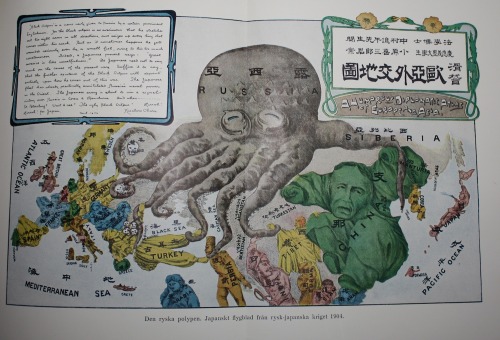
This was sent in by Johan. I think I posted a low resolution version of this a long time ago (2010); In a post on octopuses and maps. But as this is a much clearer version and shows all the wonderful details, I have no problem in reposting it.
“A Humorous Diplomatic Atlas of Europe and Asia” by Kisaburo Ohara, published March 1904 prior to the Japanese-Russian War. Based on the Serio-Comic War Map by F.W Rose (1877)6’7.
Apparently FW Rose wasn’t the originator either. There is a great post on the origins of this type of map at BigThink: 521 - Cartography’s Favourite Map Monster: the Land Octopus (2011).
“Black Octopus” is a name newly given to Russia by a certain prominent Englishman. For the black octopus is so avaricious that he stretches out his eight arms in all directions, and seizes up every thing that comes within his reach. But as it sometimes happens he gets wounded seriously even by the small fish, owing to his too much covetousness. Indeed, a Japanese proverb says: “Great avarice is like unselfishness.” We Japanese need not to say much on the cause of the present wars. Suffice it to say, that the further existence of the Black Octopus will depend entirely upon how he comes out of this war. The Japanese fleet has already practically annihilated Russia’s naval peer in the Orient. The Japanese army is about to win a signal victory over Russia in Corea & Manchuria And when………….. St Petersburg? Wait & see! The ugly Black Octopus! Hurrah Hurrah! for Japan.
Kisaburo OharaMarch 1904
6. Harwood, Jeremy, and Bendall, Sarah. To the Ends of the Earth: 100 Maps That Changed the World: Struik, 2006.
7. VADS, http://tinyurl.com/d46ldj (Accessed: 15th Feb 2009)
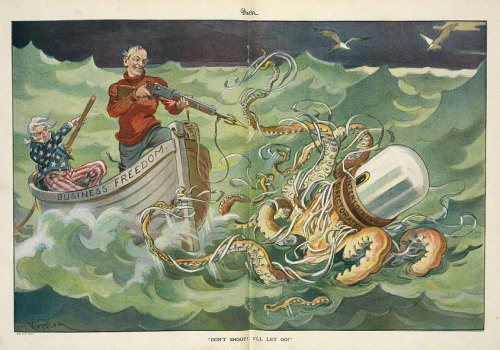
Udo J. Keppler, Don’t shoot! I’ll let go!, Januaury 31 1914, Illus. in: Puck, v. 75, no. 1926. Reproduced from: The Library of Congress, http://www.loc.gov/pictures/item/2011649666/ (Accessed: 9th March 2013)
The cartoon refers to the Clayton Act of 1914, which was an attempt by the Wilson Administration to tighten antitrust laws. Part of the act was to prevent corporations merging that had the same person as a director.
Description from the Library of Congress catalogue:
Illustration shows President Wilson about to shoot a harpoon into an octopus labeled “Interlocking Directorates” that has a grip on his boat labeled “Business Freedom”; Uncle Sam is sitting at the back of the boat with a long pole.

Louis Dalrymple, The peril of France - at the mercy of the octopus, October 26, 1898, Illus. from Puck, v. 44, no. 1129. Reproduced from: The Library of Congress, http://www.loc.gov/pictures/item/2012647482/ (Accessed: 9th March 2013).
The cartoon refers to the Dreyfus Affair, and to the corruption, deception and anti-semitism of the French Military at the time. It was published before the retrial of Alfred Dreyfus in 1899, but after the open letter ‘J'accuse’ by Émile Zola, published in January of 1898.
Print shows an octopus with the head of a French military officer (which may represent General Boisdeffre or General Gonse) wearing a plumed hat labeled “Militarism”, that has settled over Paris, France, with its tentacles extending in all directions and are labeled “Deception, Dishonor, Forgery, Assassination, Corruption, Falsehood, [and] Blackmail”; caught in their grasp are military officers Georges “Picquart” and Alfred “Dreyfus”, two female figures labeled “Honor” and “Justice”, and the author Émile “Zola” holding a quill pen labeled “J'Accuse”.
Description from: The Library of Congress, http://www.loc.gov/pictures/item/2012647482/ (Accessed: 9th March 2013).

“NOT EVEN-HANDED JUSTICE: Crushing the scorpion of anarchy but sparing the octopus of monopoly”, Artist William A. Rogers, published in Harper’s Weekly, January 21, 1888.
(Snark: Seems kind of apt, given the Occupy movement and response to it. Some things don’t change.)
Image source: Railroad Cartoons Home, http://sophia.smith.edu/~maldrich/topics/political_influence/1888harpersjan21.htm (accessed 12-11-2011)
Vulgar Army by Michelle Farran is licensed under a Creative Commons Attribution-Noncommercial-Share Alike 2.5 Australia License.